Why St. Louis Is One of FD-IX's Most Strategic Peering Locations
Published: April 21, 2026 | Read Time: 8 min | Author: FD-IX Team
Sitting at the geographic center of the continent, St. Louis has spent decades quietly becoming one of the most important crossroads for internet traffic in North America. FD-IX has been there since the beginning.
Table of Contents
- St. Louis: America's Network Crossroads
- FD-IX in St. Louis Today
- The Facilities: Where Peering Happens
- Who Is Peering at FD-IX St. Louis?
- Why the Data Center Ecosystem Is Accelerating
- Benefits of Peering at FD-IX St. Louis
- FD-IX Services and Pricing
- How to Connect
- FD-IX St. Louis on PeeringDB
- Get Started
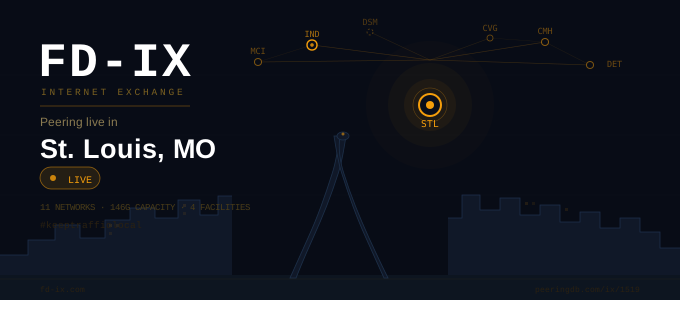
FD-IX St. Louis at a Glance
| Metric | Value |
|---|---|
| Connected Networks | 11 |
| Total Capacity | 146G |
| Facilities | 4 |
| Starting Price | $0/month |
| Uptime SLA | 99.99% |
St. Louis does not advertise itself the way coastal tech cities do. It does not need to. Draw a line from the East Coast to Denver, and traffic routes through the region. Draw a line from Chicago to Dallas, and it passes nearby. The city sits where the Missouri River meets the Mississippi, a natural convergence point that shaped two centuries of commerce, and now shapes internet routing as well. FD-IX recognized that strategic reality early and established one of its anchor nodes right in the heart of downtown St. Louis.
St. Louis: America's Network Crossroads
Geography is everything in network design. St. Louis sits almost exactly at the center of the continental United States, roughly equidistant from the East Coast, West Coast, and Gulf of Mexico. That positioning has real, measurable consequences for latency. A network based in St. Louis can reach Chicago, Dallas, and Atlanta with roughly balanced round-trip times, without the extremes that complicate connectivity from markets on either coast.
That central location also makes St. Louis a natural convergence point for fiber. Long-haul dark fiber routes that connect the coasts pass through or near the city, making it one of the most fiber-rich markets in the country relative to its population. Carriers, CDNs, and content providers that need a mid-continent presence find St. Louis an obvious choice.
Missouri's power cost structure adds another layer of appeal. Electricity rates in Missouri typically run below the national average, a meaningful advantage for power-intensive colocation deployments. And unlike coastal markets, St. Louis faces essentially no hurricane exposure, making it a reliable choice for disaster recovery and secondary infrastructure.
Geographic Advantage: Traffic moving between Chicago and Dallas passes through or near St. Louis. Traffic between the East Coast and Denver often routes through the region. That makes a St. Louis peering point valuable to networks far beyond Missouri's borders.
FD-IX in St. Louis Today
FD-IX operates its St. Louis node across four facilities, anchored by the two Netrality carrier hotels in the downtown core: 210 North Tucker Boulevard and 900 Walnut Street. These two buildings have been connected by high-capacity fiber for years, creating a unified switching fabric that spans the most network-dense blocks in Missouri.
The St. Louis node currently counts 11 peering members with 146G of total switching capacity across the fabric. Since FD-IX expanded its space at both the 210 Tucker and 900 Walnut facilities in partnership with Netrality, the exchange has had room to grow its member base, bring in more content nodes from major providers, and increase capacity to keep traffic local in what has historically been an underserved market for direct interconnection.
The Facilities: Where Peering Happens
Netrality 210 North Tucker
210 N Tucker Boulevard is widely regarded as St. Louis's premier carrier hotel. The 442,837 square-foot building aggregates traffic from all directions thanks to its position in the downtown fiber loop. It houses 42 connected networks across its Meet-Me-Room and provides direct access to major cloud providers including Cloudflare, Lumen Cloud Connect, Megaport, PacketFabric, and Zayo CloudLink. For network operators that need deep interconnection, 210 Tucker is the address in St. Louis.
Netrality 900 Walnut Street
900 Walnut is a seven-story building that serves as the region's premier internet gateway and sits one block from 210 Tucker. The two Netrality buildings are tethered by direct fiber, effectively functioning as a single, highly resilient campus. 900 Walnut is home to 39 connected networks and supports colocation, peering, and cloud connectivity under one roof, with redundant UPS, onsite generators, and diverse fiber entry points.
H5 Data Centers St. Louis (MO01)
Located at 710 North Tucker, H5 brings additional capacity and a separate physical path into the FD-IX fabric for members who need geographic diversity within downtown St. Louis.
TierPoint St. Louis - Walnut
TierPoint's presence at the 900 Walnut address adds enterprise-grade colocation and managed services to the FD-IX ecosystem at that facility. TierPoint has been expanding aggressively in St. Louis, most recently acquiring a historic building at 2300 Locust Street for conversion into a state-of-the-art enterprise data center, signaling long-term confidence in the St. Louis market.
Who Is Peering at FD-IX St. Louis?
The St. Louis fabric includes a strong mix of global content providers, regional carriers, and local networks:
| Network | ASN | Speed | Policy |
|---|---|---|---|
| Cloudflare | AS13335 | 10G | Open |
| Hurricane Electric | AS6939 | 100G | Open |
| Charter Communications | AS20115 | 10G | Selective |
| Atlantic Metro | AS29838 | 10G | Open |
| Elite Systems | AS40181 | 10G | Open |
| PCH AS42 | AS42 | 1G | Open |
| PCH AS3856 | AS3856 | 1G | Open |
| On-Ramp Indiana | AS14333 | 1G | Open |
| LTI | AS400734 | 1G | Open |
| ALSAT-WIRELESS | AS62948 | 1G | Open |
| Lockridge Networks | AS54037 | 1G | Selective |
Hurricane Electric's 100G port makes the St. Louis node particularly valuable. HE is one of the most widely peered networks in the world, and its presence at a single IX brings indirect reachability to thousands of networks globally.
Why the Data Center Ecosystem Is Accelerating
St. Louis is in the early stages of a significant infrastructure build-out, and that build-out directly expands the universe of networks available to peer with on FD-IX.
The Armory Innovation District. Developers announced a $3 billion mixed-use technology district in Midtown St. Louis in early 2026. The plan includes a 120-megawatt data center built on the adjacent Macy's warehouse property, large enough to qualify as hyperscale. The project would generate an estimated $28.2 million in year-one taxes for the City of St. Louis alone and create more than 1,000 construction jobs.
Cloverleaf Infrastructure near St. Louis. A large-scale powered land campus northeast of the city is planned to deliver up to 500 megawatts of capacity at full buildout, spanning 250 to 300 acres across multiple data center buildings totaling more than 1 million square feet. Construction is targeted to begin in early 2027. The campus is designed for hyperscale cloud and AI workloads.
TierPoint's downtown expansion. TierPoint's acquisition and conversion of 2300 Locust Street adds another enterprise-grade data center to the downtown core, further concentrating network operators in the same neighborhood as the FD-IX switching fabric.
Missouri's AI infrastructure pipeline. St. Louis-area hyperscale projects are drawing interest from major technology companies including Meta, Google, and OpenAI. As these facilities connect to downtown St. Louis carrier hotels, they will generate substantial new demand for local peering rather than long-haul transit.
The Bigger Picture: A 120MW data center complex in Midtown and a 500MW campus northeast of the city are not just construction projects. They are future peering partners, driving the value of every IX port in downtown St. Louis higher over the next two to three years.
Benefits of Peering at FD-IX St. Louis
Lower Transit Costs. Replace expensive transit with direct peering. FD-IX members routinely save $500 to $2,000 per month on bandwidth costs by sending traffic directly to content networks instead of routing it through a transit provider. With Hurricane Electric and Cloudflare on the fabric, a large portion of your internet traffic can settle locally at zero marginal cost per gigabit.
Central US Reach. A single St. Louis port gives you balanced, low-latency paths to Chicago, Dallas, Atlanta, Kansas City, and Indianapolis. For networks serving customers across a wide geographic footprint, the mid-continent location ensures predictable performance across all regions simultaneously.
Improved Resilience. The dual-facility campus at 210 Tucker and 900 Walnut provides two independent physical paths into the same switching fabric. Members with cross-connects at both buildings can achieve true N+1 resiliency for their peering sessions without building duplicate infrastructure elsewhere.
Cloudflare and Hurricane Electric On-Ramp. Reaching Cloudflare's global CDN and Hurricane Electric's massive network through a local 10G port, rather than paying upstream transit for that traffic, is one of the highest-ROI moves an ISP or content host can make. Both are on the St. Louis fabric today.
No Setup Fees or Lock-In. FD-IX does not charge setup fees or require long-term contracts.
FD-IX Services and Pricing
FD-IX publishes pricing publicly. There are no hidden costs and no lock-in contracts.
Every port includes a 1:1 dedicated connection, IPv4 and IPv6 support, route server access, 24/7 network monitoring, and technical support at no additional charge.
Remote Peering
Not every network has a colocation presence in downtown St. Louis. FD-IX's Remote IX Access service lets you backhaul traffic into the St. Louis node through a transport partner, gaining full access to the peering fabric without a physical build-out. This is ideal for regional ISPs and WISPs that serve Missouri and southern Illinois traffic but operate from a single remote facility.
Private VLANs
For networks that need isolated, dedicated interconnection with a specific peer rather than the shared fabric, FD-IX offers private VLANs at the St. Louis facilities. This is commonly used for healthcare networks requiring HIPAA-compliant traffic paths and for financial services firms exchanging sensitive data.
How to Connect
Most connections go live within seven to fourteen business days.
Step 1: Submit Your Application Complete the online connection form at fd-ix.com. The FD-IX team will confirm your technical details and identify the right facility for your needs in St. Louis.
Step 2: Order a Cross-Connect Work with Netrality, H5, or TierPoint to order a cross-connect to the FD-IX switch infrastructure. The datacenter handles physical cabling; FD-IX handles the logical configuration.
Step 3: Configure BGP Set up BGP routing with the FD-IX route servers or establish direct sessions with individual peers. Configuration assistance is included at no extra charge.
Step 4: Start Peering Begin exchanging traffic immediately with 11 direct peers and the full FD-IX fabric across the Midwest. Real-time telemetry and a 24/7 NOC monitor the connection from day one.
FD-IX St. Louis on PeeringDB
FD-IX maintains a verified listing on PeeringDB under org ID 11225. The St. Louis node is listed as FD-IX - St. Louis (IX ID 1519) with full facility and network data available for review. You can browse current peers, confirm peering policies, and initiate contact with member networks directly through PeeringDB.
The two anchor facilities also maintain their own PeeringDB profiles: 210 N Tucker (facility ID 1978) and 900 Walnut (facility ID 332). Prospective members can verify carrier and network density at each building before committing to a colocation decision.
- PeeringDB Org Profile: peeringdb.com/org/11225
- FD-IX St. Louis IX: peeringdb.com/ix/1519
- 210 N Tucker Facility: peeringdb.com/fac/1978
- 900 Walnut Facility: peeringdb.com/fac/332
Get Started
FD-IX St. Louis is live, connected, and ready for new members. Whether you are an ISP looking to cut transit costs, a content provider seeking a central US on-ramp, or an enterprise building a disaster recovery strategy around geographic diversity, the St. Louis node has a path for you.
- Get Connected: fd-ix.com
- View Pricing: fd-ix.com/services/internet-exchange-ports
- St. Louis Location Page: fd-ix.com/locations/stlouis
- PeeringDB: peeringdb.com/org/11225
- Phone: +1 (463) 209-7100
- Email: info@fd-ix.com