
How peering affects customers of peered networks
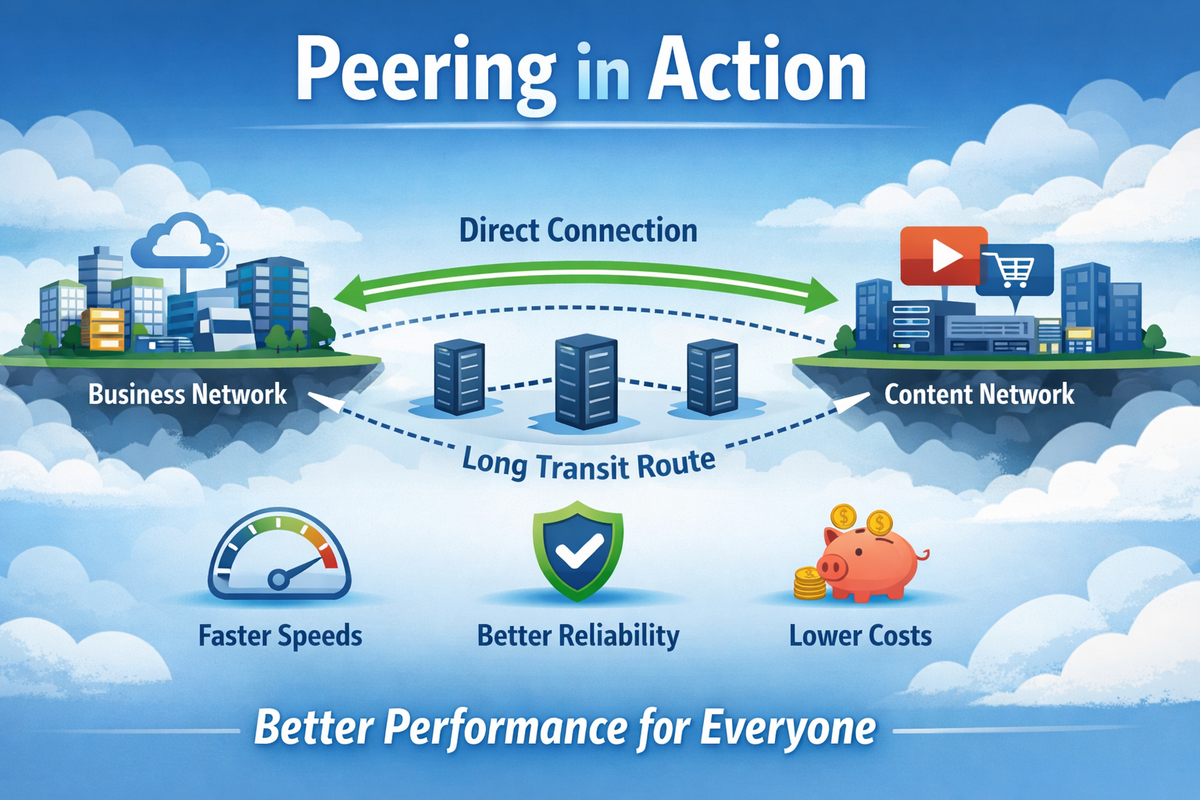
Peering might sound like a technical term, but it has real impacts on businesses and everyday internet users. Simply put, peering is when two networks connect directly. Rather than sending data through a third party, the networks agree to exchange traffic with each other.
It’s like two neighboring towns building a short road between them, so people don’t have to take a long detour on a distant highway. Data travels a shorter distance, passes through fewer stops, and gets to its destination more quickly.
Peering helps businesses deliver better performance that customers can notice. When a local ISP connects directly with content providers, cloud services, or other nearby networks, data travels a shorter route. This leads to faster website loading, smoother video calls, and fewer slowdowns during busy times. Customers might not know the reason, but they notice the difference. Speed isn’t just about bandwidth—it’s also about latency, packet loss, and reliability. Peering improves all of these.
Peering also makes networks more reliable. With several direct paths, networks don’t have to depend on just one provider. If one route fails or becomes congested, traffic can reroute to another connection. For businesses using cloud apps, VPNs, voice, or streaming, this resilience is important. Downtime is expensive, and slow service can hurt customer trust.
Peering helps control costs. Paying for transit bandwidth can be expensive, but peering allows networks to exchange traffic for little or no cost. These savings let ISPs spend more on improving their infrastructure instead of paying high transit fees. Over time, this can lead to better service options, more capacity, or slower price increases for customers. That’s always a welcome change.
Local peering has an extra advantage. When networks in the same city or region peer, traffic stays local. A customer streaming video from a nearby cache no longer sends packets across multiple states. That reduces latency and keeps local traffic local. It also strengthens the regional internet ecosystem. Networks become partners, not strangers passing packets in the dark.
Most customers never notice peering, and that’s how it should be. Websites load quickly, games respond more smoothly, videos buffer less, and cloud apps work more smoothly. The internet just works, which is exactly what people want. Peering often makes this possible.
When businesses pick an ISP, they should ask about peering. Questions like who the network connects with, where those connections are, and how much traffic they handle can reveal a lot about quality. Networks with strong peering usually run better, showing good planning and teamwork.
Peering isn’t just a marketing term—it’s like the plumbing of the internet. Good plumbing keeps things running smoothly, while bad plumbing causes problems. The internet depends on agreements as much as on cables, and peering is one of those key agreements that make everything faster, more affordable, and more reliable for everyone.