
FD-IX Expands Indianapolis Backbone to 800G via National Broadband Co-op
April 27, 2026 · Indianapolis, IN
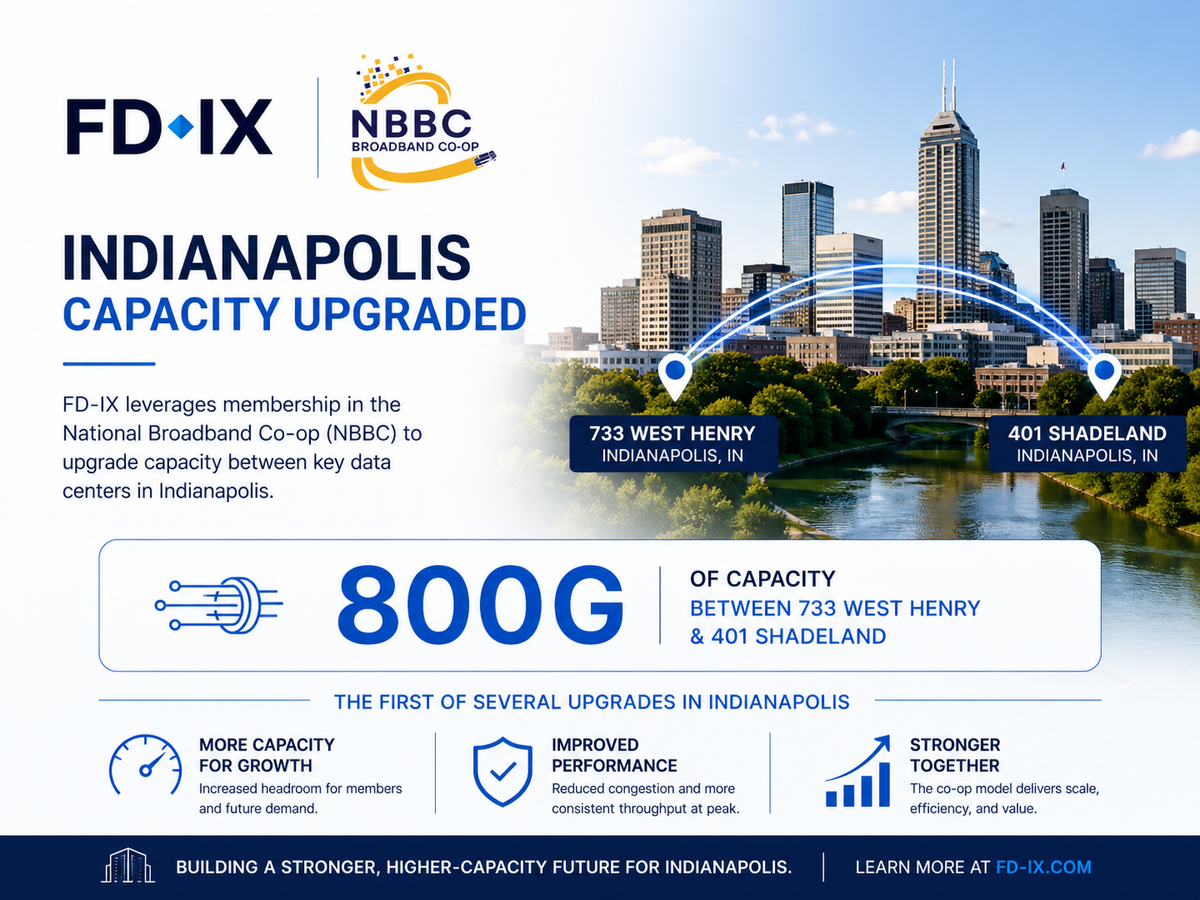
FD-IX has completed a significant upgrade to its Indianapolis backbone, increasing transport capacity to 800 gigabits per second (800G) between two of the region's primary interconnection facilities: 733 West Henry and 401 North Shadeland. The expansion was made possible through FD-IX's participation in the National Broadband Co-op (NBBC), a cooperative infrastructure model that pools member demand to accelerate network investment across the region.
The upgrade delivers immediate benefits to current FD-IX members exchanging traffic across the Indianapolis fabric and creates the headroom needed to support continued peering growth and new port activations at both sites.
Why 800G Between These Two Sites Matters
The span between 733 West Henry and 401 North Shadeland is one of the most heavily utilized routes on the FD-IX Indianapolis network. As member traffic volumes have increased, so has the importance of maintaining sufficient capacity on this metro link to prevent congestion during peak periods.
Upgrading to 800G on this route substantially reduces the risk of congestion. For members already exchanging traffic at Indianapolis, this means more consistent latency and throughput as aggregate traffic grows. For networks considering new ports or peering sessions at either facility, the upgrade signals that the underlying infrastructure is ready to scale alongside them.
How the National Broadband Co-op Enables Faster, Larger Upgrades
The co-op structure behind this upgrade is worth understanding because it directly affects how FD-IX can scale over time. Rather than negotiating and funding transport capacity individually, FD-IX leverages its NBBC membership to aggregate demand alongside other co-op participants. That aggregated demand gives the co-op significantly greater purchasing power and enables capacity increments that would be harder to justify or finance on a standalone basis.
The practical result is that upgrades like this 800G expansion happen earlier in the traffic growth curve and at larger step sizes. Networks on the FD-IX fabric benefit from infrastructure that is already ahead of current demand rather than catching up to it.
"This increase to 800G between key Indianapolis sites gives our members more consistent performance as traffic grows. We can add ports and peers on our Indianapolis fabric without capacity worries."Justin Wilson, FD-IX
First in a Series of Planned Indianapolis Expansions
This upgrade is not a one-time event. FD-IX and the NBBC have identified additional routes within Indianapolis that carry the highest traffic volumes, and future capacity increases are already planned for those spans. Each successive upgrade will further increase aggregate capacity across the FD-IX Indianapolis footprint while also expanding the overall value of NBBC infrastructure for co-op participants.
What This Means for Networks Considering Indianapolis Peering
For networks evaluating an Indianapolis point of presence, the state of the underlying IX infrastructure is a meaningful factor in that decision. A well-capitalized backbone reduces the risk of early growth encountering bottlenecks, and a co-op-backed upgrade roadmap provides visibility into how that infrastructure will continue to evolve.
FD-IX serves networks at both 733 West Henry and 401 North Shadeland in Indianapolis. Port options and current peering data are available through PeeringDB, and the FD-IX team is available to discuss interconnection options directly.
Connect at FD-IX Indianapolis
To learn more about peering at FD-IX's Indianapolis locations or to explore port availability, visit fd-ix.com or reach out to the FD-IX team directly. As this planned series of backbone expansions continues, now is a strong time to establish or expand a presence on the FD-IX Indianapolis fabric.
About the National Broadband Co-op (NBBC)
The National Broadband Co-op is a member-owned cooperative based in Indiana that provides wholesale broadband infrastructure and services to a network of internet service providers across the state and the broader Midwest. More information about the National Broadband Co-op is available at nbbc.coop.