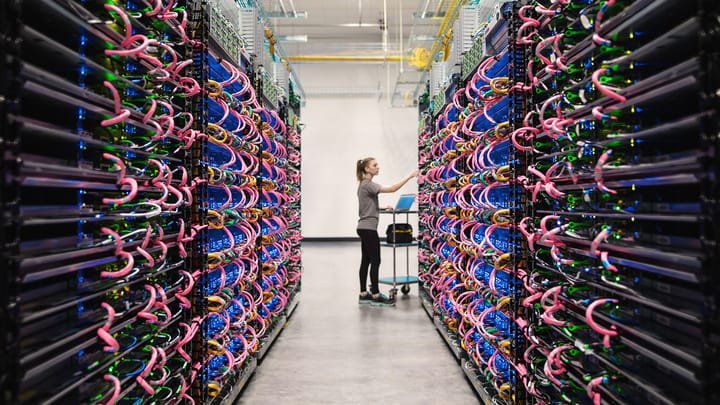
AI Needs Infrastructure, Not Just Compute
AI workloads differ significantly from traditional application traffic. Rather than users clicking links and retrieving content, AI involves sustained east–west data movement between tightly coupled systems.
Discussions of artificial intelligence (AI) often emphasize graphics processing units (GPUs), which is understandable given that training clusters, inference farms, and model sizes all scale with computational resources. However, this perspective overlooks a critical production constraint: network performance ultimately determines whether GPUs remain fully utilized or become idle.
AI workloads differ significantly from traditional application traffic. Rather than users clicking links and retrieving content, AI involves sustained east–west data movement between tightly coupled systems. Training jobs transfer datasets, gradients, and checkpoints across clusters in coordinated waves. If the network cannot maintain pace, overall system performance degrades regardless of computational power.
The Bottleneck Shifts Beyond the GPU
In practical deployments, the bottleneck often shifts rapidly. Distributed training frameworks require rapid synchronization between nodes, necessitating both high throughput and low latency. If either requirement is not met, the result is stragglers, retries, and wasted computational cycles.Traditional network design reveals its limitations in this context. Legacy interconnection architectures were developed for north–south flows, where content originated on a server and was delivered to an end user. AI workloads invert this model: traffic remains within the network fabric and moves laterally between interdependent systems in real time. Optimization priorities shift from reach to density and consistency.
AI Traffic as Infrastructure Traffic
AI traffic does not exhibit the bursty characteristics typical of web traffic. Instead, it is heavy and sustained. When a training job initiates, it consumes bandwidth continuously, resulting in spikes that resemble traditional backup windows rather than standard application flows.This shift necessitates a reevaluation of interconnection strategies. Peering can no longer be treated as a best-effort service. Predictable latency and sufficient capacity to absorb traffic spikes are essential. Without these provisions, hidden congestion may emerge under load.
Why FD-IX.ai Exists
FD-IX.ai addresses this infrastructure gap by providing a network fabric optimized for AI workloads. The objective is to enable seamless operation without contention for underlying transport resources. This requires high-capacity ports, minimal path lengths between participants, and a topology designed for east–west traffic dominance.Rather than routing traffic through multiple hops across the public internet, participants can exchange data directly within a controlled environment. This approach reduces jitter, minimizes unnecessary transit, and keeps large data movements local to the fabric. Such improvements can determine whether a job completes on schedule or experiences significant delays.
Latency Is Only Half the Story
While latency is important, it does not encompass the entire challenge. AI workloads require sustained throughput without drops or microbursts that could trigger retransmissions. A low-latency path that fails under load is as detrimental as a consistently high-latency path. Networks must maintain performance under stress, necessitating efficient routing and sufficient capacity to prevent bottlenecks. Infrastructure designed for AI must assume that peak load conditions are standard.
Interconnection as a Primary Design Consideration
In previous network models, interconnection was frequently considered after initial deployment. Networks were constructed first, with connectivity to external systems addressed subsequently. In AI environments, however, interconnection is integral to core design. The location, directness, and capacity of connections directly influence workload performance.This is why purpose-built exchange points matter. They act as aggregation layers for high-performance traffic. Instead of every network solving the same problem in isolation, the fabric provides a shared environment optimized for the workload type. That is a more efficient model.
The Simple Reality
If GPUs remain idle due to network limitations, the AI platform is not operating efficiently, resulting in wasted resources. The underlying infrastructure determines the extent to which computational investments translate into productive outcomes.AI has not only increased bandwidth demands but also altered traffic patterns and reduced tolerance for inconsistency. Infrastructure solutions such as FD-IX.ai have emerged in response to the inadequacy of previous assumptions.